
Texas Inmate Population
Texas inmate population records are spread across county jails, state prisons, and federal facilities throughout the state. Each of the 254 counties runs its own jail under an elected sheriff, while the Texas Department of Criminal Justice manages the state prison system and more than 100 correctional units. You can search for county jail inmates through individual sheriff's office portals, or look up state prison offenders through TDCJ. This guide covers the main tools and agencies used to find Texas inmate population data, how each system works, and how to reach the right office for current custody information.
Texas Inmate Population Overview
Where to Search Texas Inmate Population Records
Texas inmate population records come from two separate systems. County jails hold people who are arrested and awaiting trial, serving short sentences, or waiting to transfer to a state facility. The Texas Department of Criminal Justice runs the state prison system and houses those convicted of felonies with longer sentences. Knowing which system holds the person you are searching for is the first step before you start.
The Texas Department of Criminal Justice maintains an offender search tool at offender.tdcj.texas.gov. You can search by name, TDCJ number, or State ID (SID). The system shows current facility placement, charges, and sentence details. It covers all active TDCJ units and includes both active and inactive offender records.
For county jail inmates, there is no single statewide portal. Each county sheriff runs its own system. Some counties have online rosters that update in real time. Others require a phone call to the jail. Harris County, Dallas County, Tarrant County, and Bexar County all have public online inmate search tools. Smaller counties often use phone-only systems. Use the county pages on this site to find the right contact for any Texas county.
Texas Department of Criminal Justice
The Texas Department of Criminal Justice is the second-largest state prison system in the United States. TDCJ is headquartered in Huntsville, Texas, with an administrative office in Austin at the Price Daniel Sr. Building. The agency manages more than 100 correctional facilities. It handles community supervision (formerly adult probation), inmate programs, and the release of offenders through parole or mandatory supervision. The main phone number is (936) 295-6371. The mailing address is P.O. Box 99, Huntsville, Texas 77342-0099.
The TDCJ Ombudsman Program serves as the public contact point for general inquiries. It is a single point of contact for elected officials and the general public. The Ombudsman can be reached at (936) 437-4927, by fax at (936) 437-8067, or by email at ombudsman@tdcj.texas.gov. For parole-related questions, the Parole Division Ombudsman is located at P.O. Box 13401, Capitol Station, Austin, Texas 78711, phone (512) 406-5795.
The TDCJ website at tdcj.texas.gov provides a facility directory, career opportunities, news updates, and family service announcements. Families can access the TDCJ Connections portal for authorized users.
The TDCJ main website is the starting point for state-level inmate population searches in Texas.

TDCJ provides direct access to offender search, statistical data, and facility information for families and the public searching the Texas inmate population.
Texas County Jail Inmate Population
Each of Texas's 254 counties maintains its own jail under the supervision of the county sheriff. County jails hold people who have been arrested and not yet released on bond, those serving sentences under two years for misdemeanors, and those waiting for transfer to a TDCJ state facility. Jail population levels vary widely. Harris County, the largest, holds roughly 9,400 inmates at capacity. Many small rural counties hold fewer than 50 people at any given time.
Several of the larger counties offer direct online inmate searches. Harris County's inmate search lets you look up by last name, first name, SPN (Sheriff's Person Number), or date of birth. The system shows the booking number, jail location, current charges, bond information, and court dates. Harris County also maintains an inmate information line at (713) 755-5300, available 24 hours a day.
Tarrant County's inmate search portal uses a CID (County Identification Number) system. You can search by last name, first name, or CID number. Results show current custody status, bond information, book-in date, and active bookings. The Tarrant County jail information line is (817) 884-3116. Most city jails in Texas, including those in Fort Worth and Dallas, transfer inmates to the county facility within 24 to 72 hours of arrest.
The Texas Commission on Jail Standards tracks population data for all county jails statewide through monthly reports. These reports show current inmate counts by county and are public records.
TDCJ Death Row Inmate Population
TDCJ maintains a complete death row database at tdcj.texas.gov/death_row. The database covers both current death row inmates and those who have been executed since 1982. Records show more than 596 executions through 2025. Each entry includes the TDCJ number, full name, age at execution, execution date, race, and the county of conviction. The database also links to last statement transcripts for each executed offender.
Current death row inmates are housed at the Polunsky Unit in Livingston, Texas. Each inmate's record includes their TDCJ number, name, date of birth, gender, race, date received on death row, county of conviction, and date of the offense. Harris County leads all Texas counties in death row convictions, followed by Dallas, Bexar, and Tarrant. Executions are carried out at the Huntsville Unit.
The death row database is one of the few areas where detailed individual inmate information from TDCJ is fully public under Texas law.
The TDCJ death row page provides access to the executed offender database and current death row inmate listings.
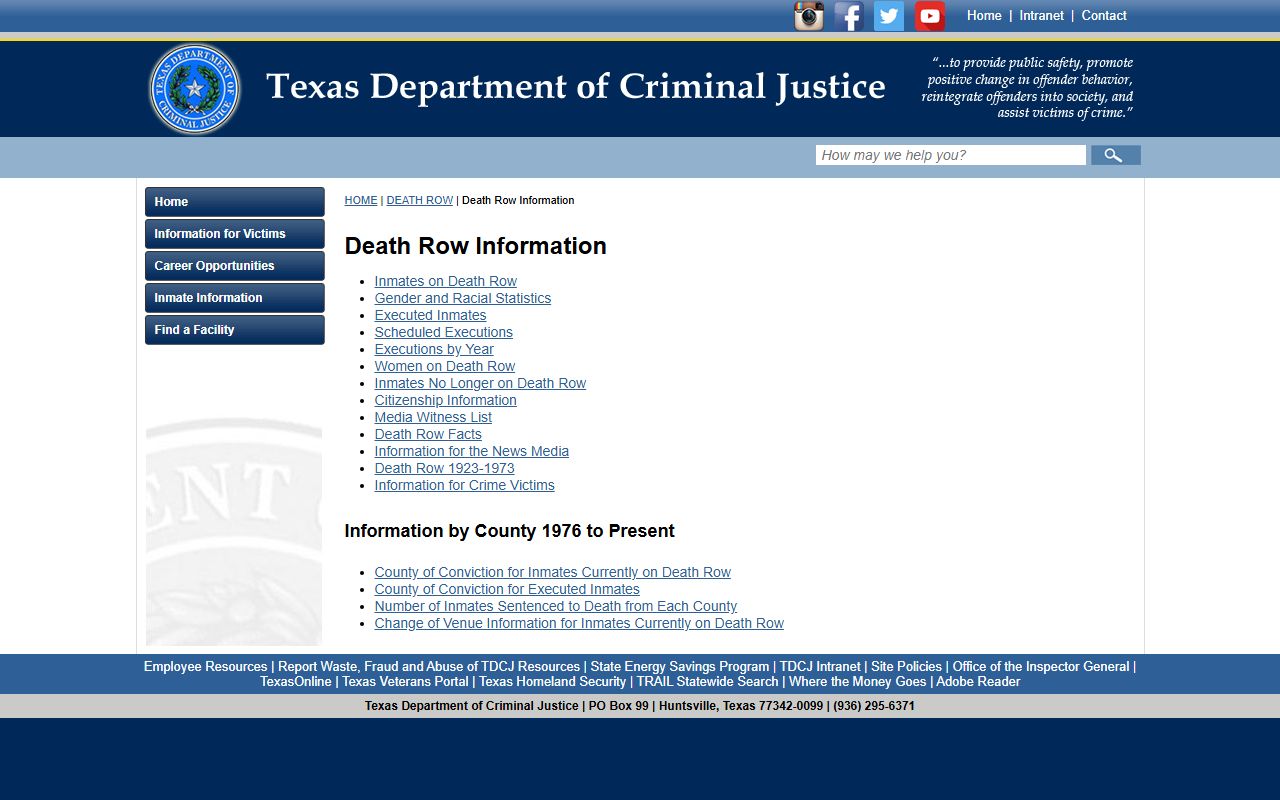
The database is updated regularly and includes both historical records and current death row population data for Texas inmates.
Texas DPS Crime Records Service
The Texas Department of Public Safety Crime Records Division acts as the state control terminal for all criminal justice information. The division runs eight state and national criminal justice programs. It provides 24/7 access to mission-critical law enforcement systems, including the Computerized Criminal History (CCH) database, the Texas Crime Information Center (TCIC), and the National Crime Information Center (NCIC) access point.
DPS Crime Records collects data from local criminal justice agencies, compiles it into statewide databases, and forwards it to the FBI's national system. The division also handles non-criminal justice fingerprint requests and background checks. It serves as a clearinghouse between local agencies and national databases. For public inquiries, visit dps.texas.gov to learn about available services and record request options.
The DPS Crime Records Service is the official gateway to Texas criminal history and law enforcement data.
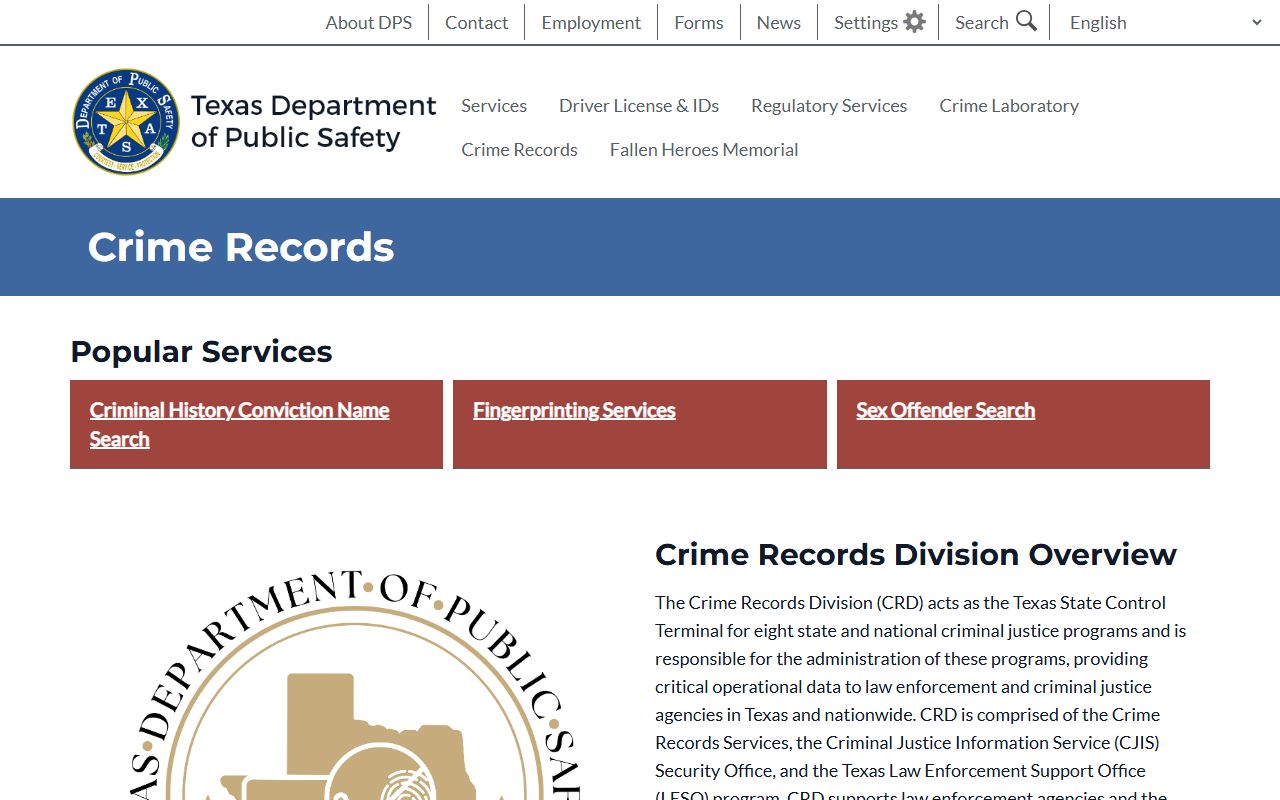
DPS Crime Records serves law enforcement agencies and the public with access to Texas criminal history, background check services, and related inmate and offender data.
Texas Commission on Jail Standards
The Texas Commission on Jail Standards (TCJS) was created by the Texas Legislature in 1975. Its mission is to make sure all county and municipal jails meet minimum standards set by the state. TCJS covers more than 240 jails in Texas. The agency requires monthly inmate population reporting from every facility under its jurisdiction. It also handles inspection, enforcement, and technical assistance for jail operators throughout the state.
TCJS jurisdiction has expanded over the decades. In 1983, it added oversight of county and municipal jails operating under vendor contracts. By 1991, it took on responsibilities for managing inmate transfers and counts during crowded conditions. The standards TCJS enforces cover construction, equipment, maintenance, custody and care of inmates, programs of rehabilitation, and educational and recreational programs. Current minimum standards are available through the Texas Secretary of State's website.
The TCJS website gives the public access to jail inspection records, population reports, and compliance information for Texas county jails.

TCJS is the state oversight body for Texas county jails, and its population reports are essential tools for tracking inmate population trends across all 254 counties.
Monthly population reports are published at tcjs.state.tx.us/population-reports. These reports show the count of inmates held in each county jail, broken down by category. The data is public and covers all facilities regulated by TCJS.
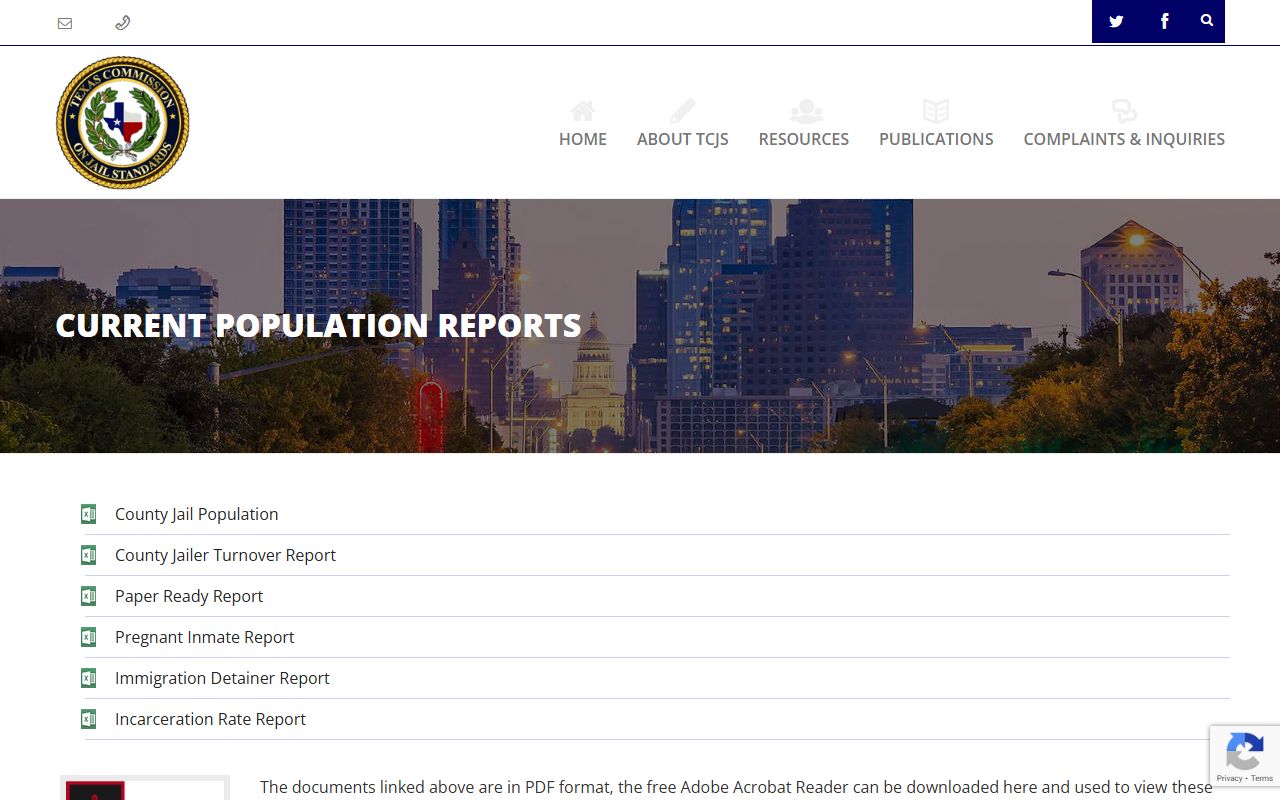
The TCJS population reports are updated monthly and provide one of the only statewide views of Texas county jail inmate population across all counties.
Texas Public Records Law and Inmate Data
Access to inmate population records in Texas is governed by Texas Government Code Chapter 552, known as the Texas Public Information Act. The law states that every person is entitled to complete information about the affairs of government. Under the Act, agencies must respond to public information requests within 10 business days. Basic arrest information is generally available to the public. This includes a person's name, age, address, the charge against them, and where they are held.
Texas Government Code Section 552.134 creates a specific exception for TDCJ state prison inmates. Under this section, most individual inmate information held by TDCJ is confidential. However, two key exceptions apply: statistical and aggregate data about the inmate population is public, and information about inmates sentenced to death is public. This means families and researchers can access population-level data without restriction, but records about specific individual state prison inmates may be limited.
Section 552.108 provides a separate exception for law enforcement records. Certain investigative materials can be withheld if release would interfere with an ongoing investigation or endanger someone's safety. However, basic booking information must still be released. This includes the name, age, and charge for anyone arrested. Copy fees under Chapter 552 are $0.10 per standard page. Personnel time charges may apply for requests over 50 pages.
The Texas Public Information Act is the legal foundation for public access to inmate and jail records in Texas.
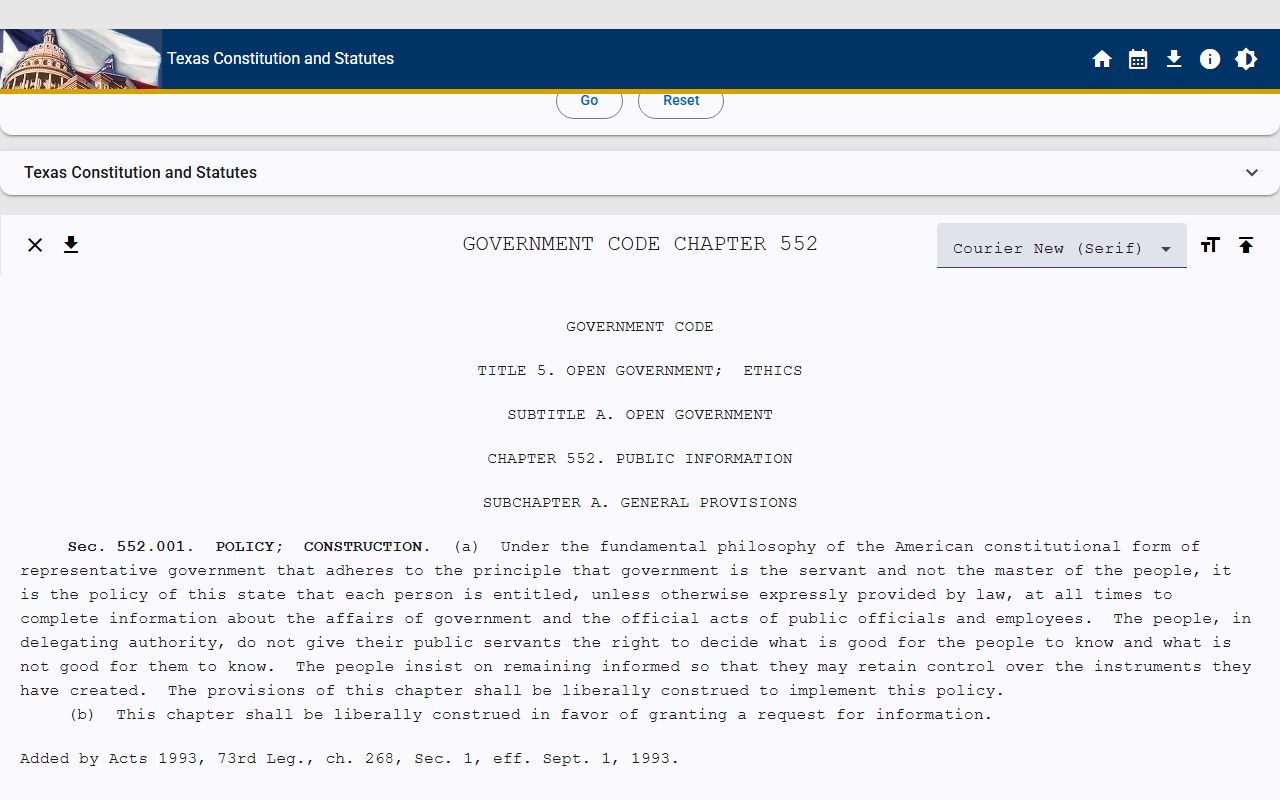
The statute text and guidance from the Attorney General's office help members of the public understand what inmate population records they can request and how to obtain them.
The Texas Attorney General's office provides open government guidance and handles complaints about agencies that refuse public records requests. Visit texasattorneygeneral.gov/open-government for handbooks, training resources, and advisory opinions on public information access.

The Attorney General's open government resources are a key tool for anyone seeking access to Texas inmate population data who encounters resistance from a county or state agency.
VINE Victim Notification for Texas Inmates
VINELink is the nation's most widely used victim notification network. Texas participates statewide. The service covers county jails, state prisons, and juvenile facilities across Texas. VINE stands for Victim Information and Notification Everyday. It lets anyone check an inmate's custody status at any time and sign up for automatic alerts when that status changes.
You can access VINELink online at vinelink.com, through the free mobile app for iOS and Android, or by calling the toll-free number at 1-866-277-7477. Service is available 24 hours a day, 365 days a year, and supports more than 200 languages. Notifications are sent by email, text, or phone call. Types of alerts include custody status changes, release from jail or prison, transfers to another facility, and court case updates. The system covers more than 2,900 facilities nationwide.
The VINELink service is a reliable way to track inmate population movements for specific individuals across Texas facilities.
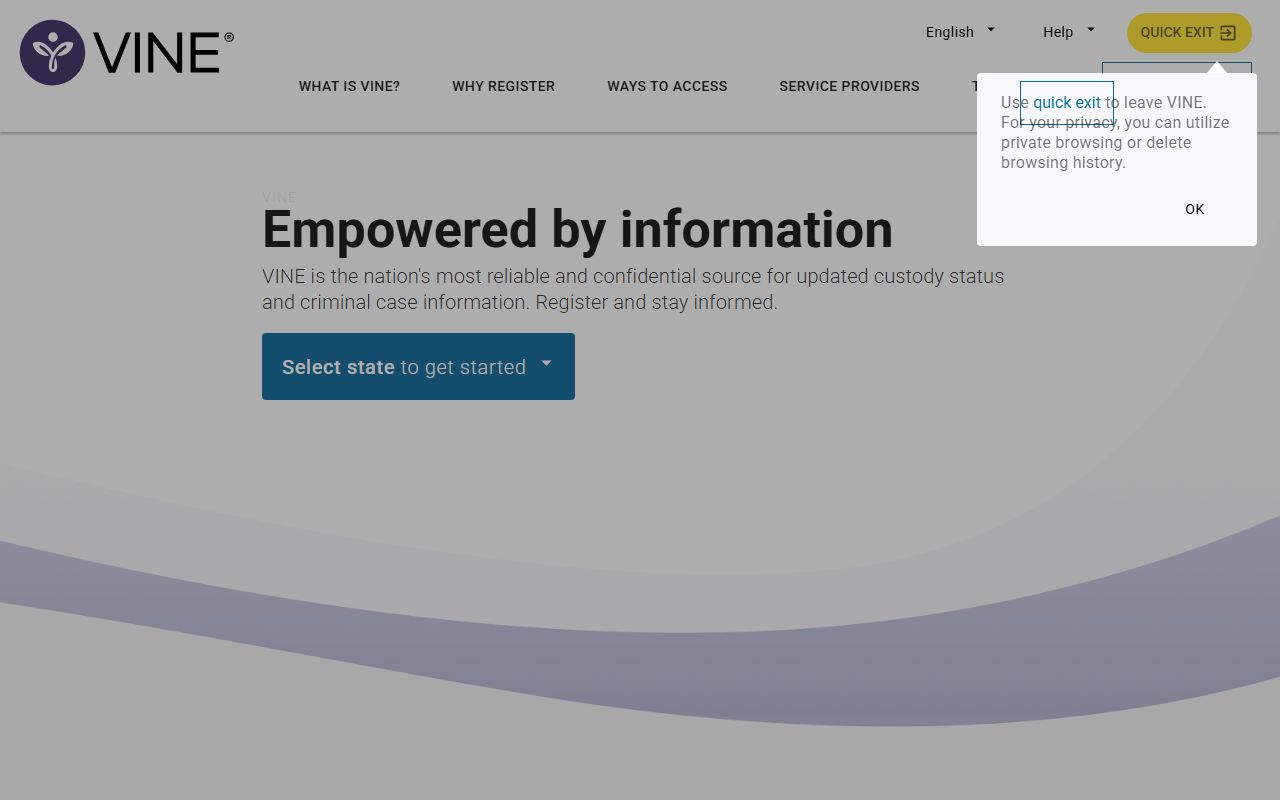
VINE is free to use and provides real-time custody notifications for Texas county jail and state prison inmates, making it useful for families and attorneys tracking inmate location changes.
Federal Inmate Population in Texas
Texas has several Federal Bureau of Prisons facilities. If a person was convicted of a federal offense, they are held in the federal system rather than a state or county jail. The BOP Inmate Locator at bop.gov/inmateloc lets you search by name or BOP register number. Results show the inmate's current facility, projected release date, and age. The search is free and available to the public at any time.
The Federal Bureau of Prisons inmate locator is the official tool for finding individuals held in federal custody in Texas and across the United States.
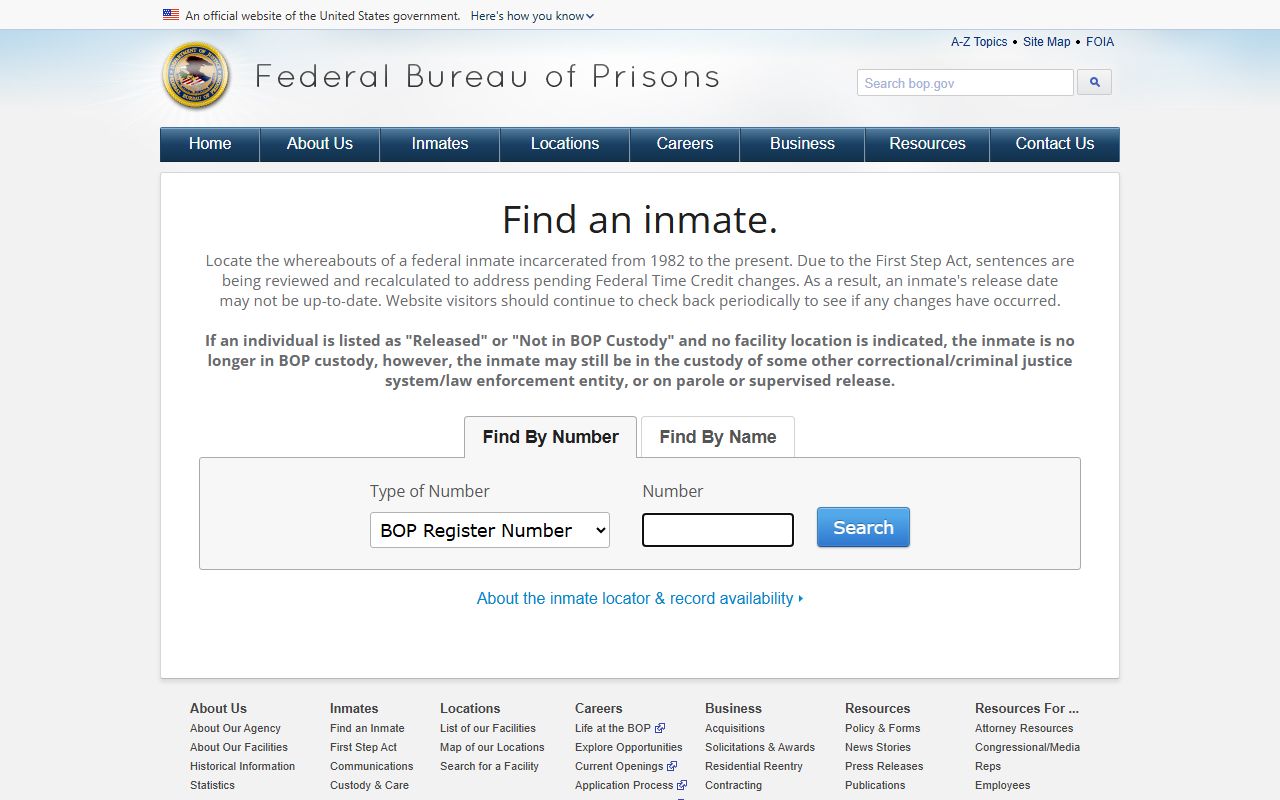
Federal inmates in Texas are not included in TDCJ or county jail records, so the BOP locator is the correct resource for anyone searching for a person held on federal charges.
Texas Juvenile Justice Records
The Texas Juvenile Justice Department (TJJD) was formed in 2011 by combining the Texas Youth Commission and the Texas Juvenile Probation Commission. TJJD handles high-risk youth committed through the juvenile court system. It is entirely separate from the adult criminal justice system. Juvenile records in Texas are confidential by law. They are not available through public inmate search portals. Only about 1% of youth referred to juvenile justice are committed to TJJD facilities. Texas ranks 27th among all states in its rate of juvenile commitments.
For juvenile probation contacts by county, TJJD maintains a searchable directory at tjjd.texas.gov. Open records inquiries for TJJD can be sent to open.records@tjjd.texas.gov. Legal questions go to legalhelp@tjjd.texas.gov.
The TJJD website provides information on Texas juvenile justice programs, facility locations, and probation resources by county.

TJJD resources are separate from adult inmate population records and should only be used when searching for individuals who were involved in the juvenile justice system in Texas.
The TJJD juvenile probation directory lets you look up probation departments by county across Texas.
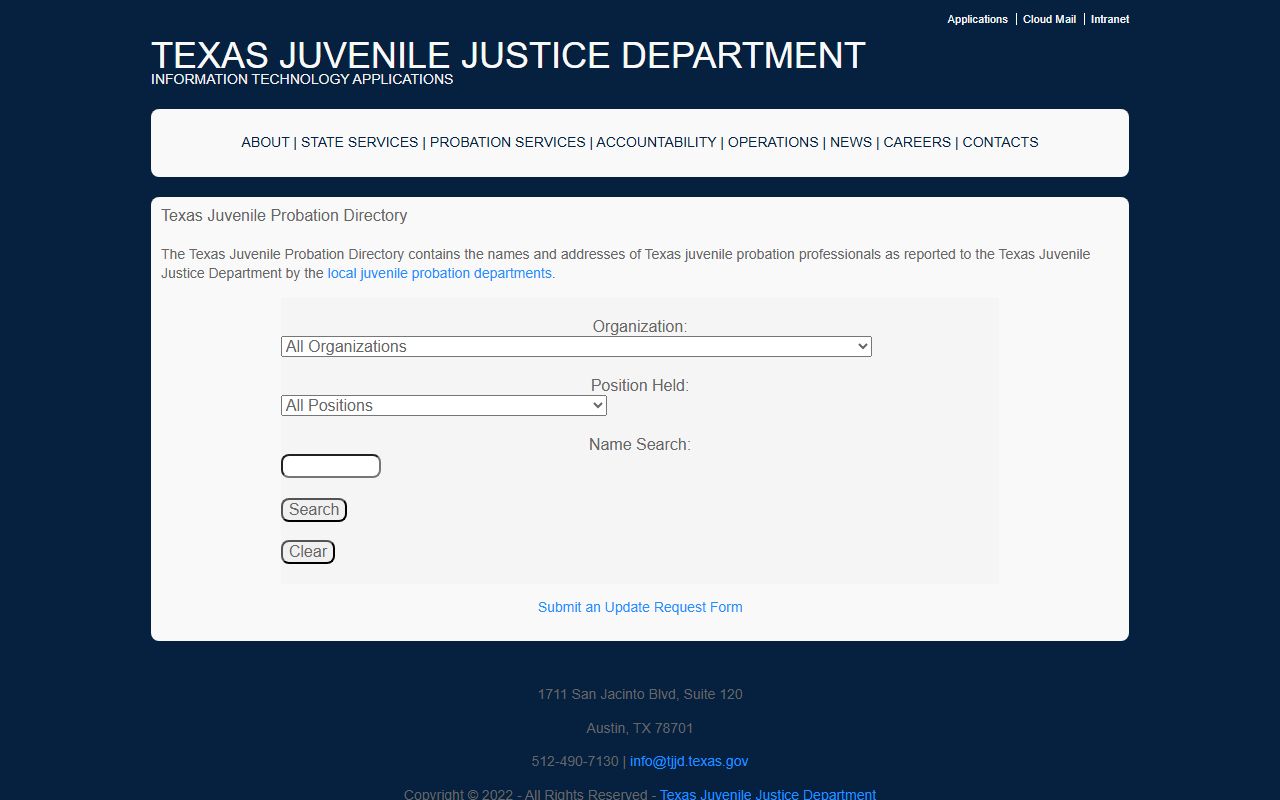
The directory is updated regularly and covers juvenile probation offices in all 254 Texas counties, linking families and courts to the right local contacts.
Texas Inmate Population Statistics
TDCJ publishes detailed population data at tdcj.texas.gov/statistics. The reports include death row numbers, health services statistics such as HIV and tuberculosis rates, and demographic breakdowns of the state prison population. Business and finance statistics, agency performance data, and long-term population trend reports are all available at no cost. These are official government records and are updated on a regular schedule.
The statistical data covers average sentence lengths by facility and offense type, inmate age and gender breakdowns, racial demographics, and recidivism figures. Researchers, attorneys, and families can access all of this data without a formal public records request.
TDCJ statistical reports give a broad picture of the Texas state inmate population, while TCJS monthly reports fill in the county jail side of the data.
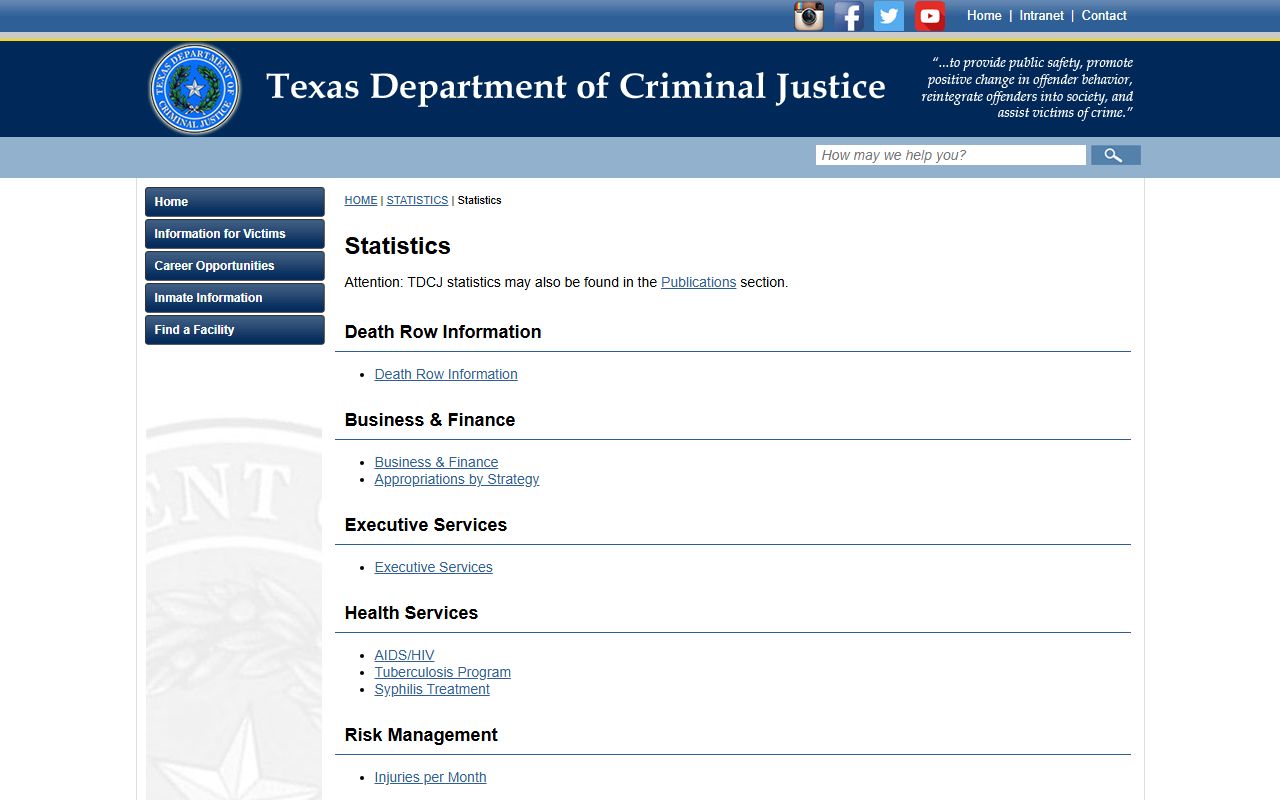
Together, TDCJ and TCJS statistics provide a near-complete view of the Texas inmate population at both the state prison and county jail level.
Browse Texas Inmate Population by County
Each of Texas's 254 counties maintains its own jail and inmate roster under an elected sheriff. Select a county below to find local contact information, inmate search portals, and resources for that county's jail population.
Texas Inmate Population by City
Major Texas cities use county jail systems for inmate housing after the initial holding period. Select a city below to find the county jail, contact information, and local inmate search resources for that area.